Overview
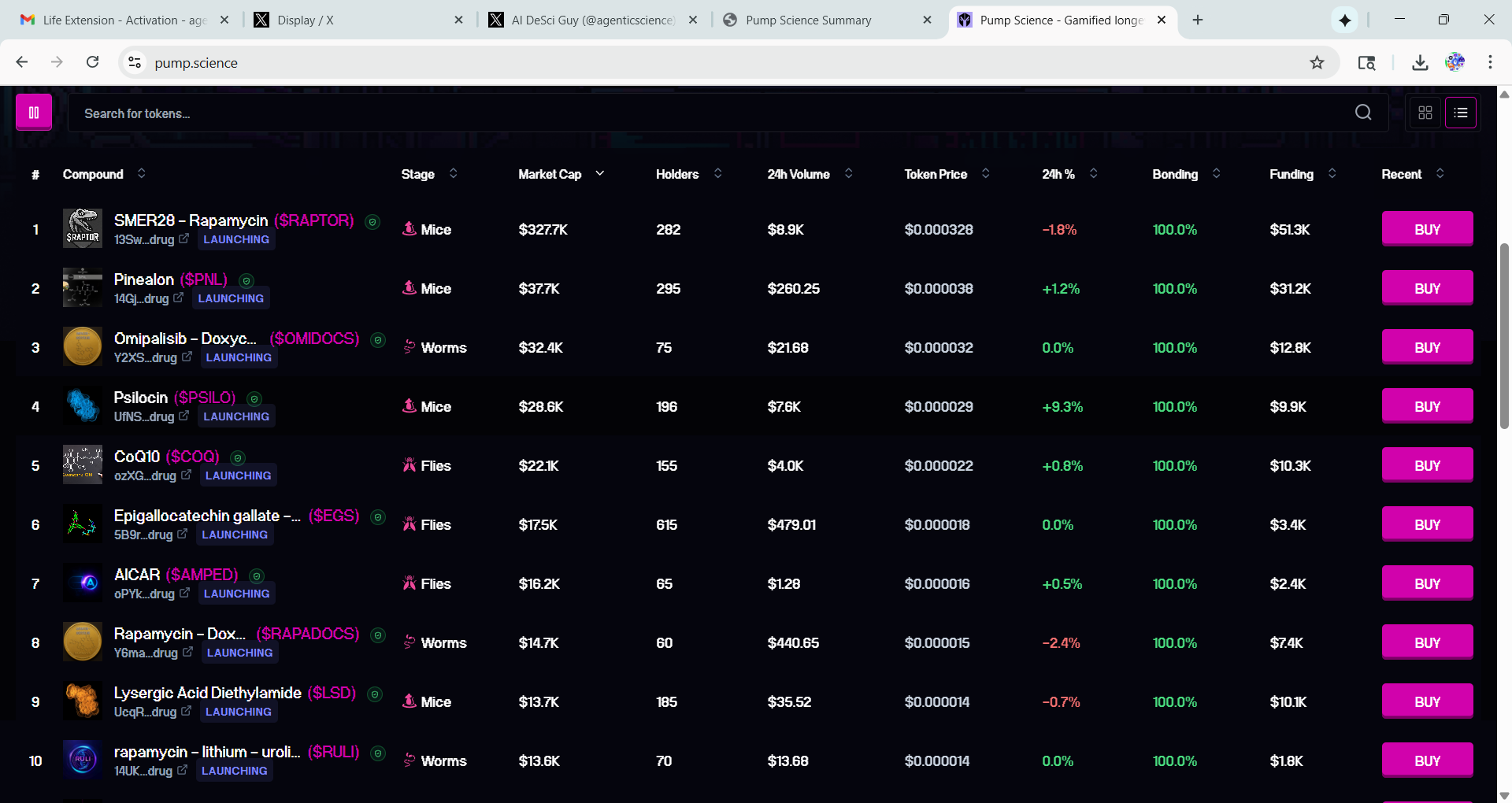
Pump Science is a blockchain platform within the Decentralized Science (DeSci) movement. It focuses on funding longevity research by tokenizing experiments on the Solana blockchain, enabling public investment in anti-aging studies starting with simple organisms like worms and scaling to mice. The platform emphasizes transparency via real-time data sharing and is not financial advice.
Core Concept and Relation to DeSci
- Definition: Creates tradable crypto tokens tied to compounds tested for longevity, funding experiments while token values reflect results, forming prediction markets.
- DeSci Integration: Builds on Molecule’s IP-NFTs, using memecoin mechanics from Pump.fun to create a community-driven research economy.
- Innovation: Democratizes funding, streams live data, and supports speculative trading to accelerate science.
History and Origins
- Launch: Debuted September 2024 at Solana’s Breakpoint by Paul Kohlhaas, developed in three weeks with a Solana Foundation grant.
- Inspiration: Uses Ora Biomedical’s WormBot for testing longevity in C. elegans, founded by Matt Kaeberlein and Mitchell Lee.
- Challenges: November 2024 GitHub key leak led to fake tokens; team renamed Pump.fun profile to "dont_trust," partnered with Blockaid, and blacklisted addresses.
How It Works
Pump Science operates in stages:
- Proposal and Token Creation: Researchers submit compounds; approved ones get tokens (e.g., $RIF, $URO).
- Funding: Token purchases fund experiments, released in phases.
- Experiments: Tests on worms (WormBot), flies (FlyBox), and mice (MouseWatcher).
- Monitoring and Trading: Real-time dashboards allow tracking and trading based on outcomes.
- Roles: Drug developers propose; token holders fund, vote, and speculate.
Key Features
- Decentralized Funding: 75% of trading fees fund experiments, 25% to platform.
- Tokenized Markets: High liquidity with anti-bot fee structures.
- Open Data: Public, real-time results reduce fraud.
- Governance: Community votes on proposals.
- Ethics: Focuses on longevity (e.g., 20-30% lifespan extension in worms).
Tokenomics of $RIF and $URO
- Supply: 1 billion tokens each; 79.3% for public buys, 15.7% for liquidity, 5% for airdrops.
- Mechanics: Starts at ~$5,000 valuation; fees fund stages; airdrops reward success.
Roadmap
- Q1 2025: Mouse tests for $RIF/$URO, VitaDAO partnerships, supplement marketplace.
- Q2 2025: Decentralized human trials, broader experiments.
Investment Considerations
High-reward potential but risks include token volatility, regulatory gaps, ethical concerns, and blockchain security. Due diligence is advised.
Conclusions
Pump Science revolutionizes longevity research via crypto, critiquing traditional funding’s inefficiencies. It offers empowerment but carries risks. Visit the platform to engage with tokens. References include Pump Science docs and DeSci projects.