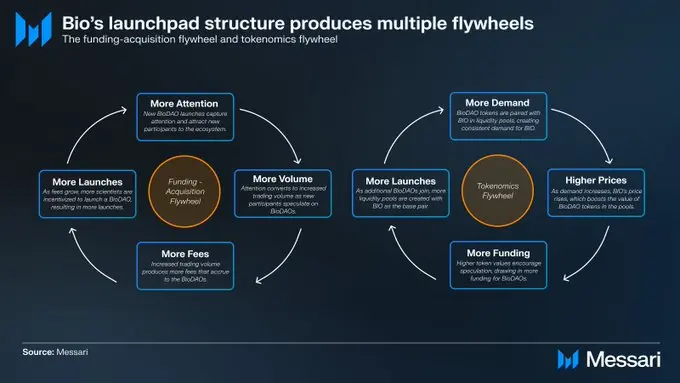
Decentralized Science (DeSci) leverages blockchain technology to democratize scientific research funding, execution, and commercialization. At its core is the DeSci value flywheel, a self-reinforcing economic cycle that transforms community-backed research into sustainable, revenue-generating ecosystems. This model addresses traditional science's challenges—like centralized funding gatekeepers, slow commercialization, and limited incentives—by using IP Tokens to enable onchain funding, product development, and value redistribution. Successes in one cycle amplify the next, creating momentum where breakthroughs attract more capital and participation.
The flywheel operates as a loop:
1. Communities fund early-stage research via IP Tokens.
2. Research advances to commercialization, generating revenue.
3. Revenue flows back to token holders through diverse mechanisms.
4. Rewards incentivize further funding, scaling the ecosystem.
This creates economic viability for decentralized science, with projects like Cerebrum DAO, Pump Science (with 73+ compounds), and Bio Protocol (AI-generated hypotheses) demonstrating real-world progress toward market-ready products.
Below is a structured breakdown of the mechanics, drawing from key DeSci frameworks (e.g., Molecule's model) and implementations (e.g., Bio Protocol's ecosystem).[31]
1. Funding Research with IP Tokens
Core Mechanism: IP Tokens are blockchain-based assets representing fractional ownership or governance rights in intellectual property (IP) from scientific research. They enable open, permissionless funding where anyone can contribute to projects onchain, bypassing traditional venture capital or grants.
How It Works:
Communities pool resources via tokens to support hypotheses, experiments, or early-stage labs.
Tokens often include governance features, allowing holders to vote on project directions, milestones, or resource allocation.
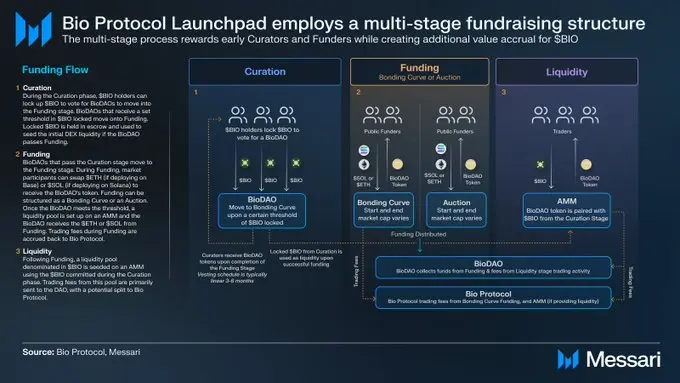
Examples: In Bio Protocol, users stake $BIO tokens to earn BioXP (experience points), which grant access to "Ignition Sales"—permissionless funding pools for new BioDAOs (Decentralized Autonomous Organizations focused on biotech). Pools start in USDC for stability, then shift to $BIO/Asset pairs post-traction.[10]
Oversubscription ratios (e.g., 14.6x for Aubrai) ensure pro-rata allocations with 0.5% caps to prevent whale dominance, fostering fair participation.
Incentives: Early funders gain exposure to high-upside IP, with mechanics like 20% TGE (Token Generation Event) vesting + 80% linear over 30 days to align long-term interests.[11]
2. Commercialization and Revenue Generation
Process: Funded research aims for marketable outputs, such as drugs, therapies, or tech. Onchain tools track progress transparently, from AI-generated hypotheses to preclinical trials.
Key Steps:
Research validation: Projects use tools like AI agents (e.g., Bio Protocol's Aubrai generating 3K+ hypotheses) and community-verified data (e.g., via BioAgents earning per-block rewards for validated inputs).[15]
Milestones: Tokenized IP-NFTs (non-fungible tokens representing IP rights) unlock as projects hit gates, such as PoC (Proof of Concept) in mice models or Phase 1 trials.
Revenue Streams: Licensing deals, product sales, or IP sales generate income. For instance, Pump Science's compounds or Cerebrum DAO's neuroinflammation research (e.g., galectin-3 inhibitors for Alzheimer's) progress toward commercialization, with fees recycling into the ecosystem.[20]
Examples: Bio Protocol has routed $50M+ to labs, with successes like Curetopia advancing to Phase 3 and Aubrai recirculating $400K in LP (liquidity provider) fees back into IP.[13] This demonstrates how early funding yields tangible returns, as seen in 13.5x-20x FDV (Fully Diluted Value) flips for projects like BiomeAI.
3. Reward Mechanisms for Token Holders
DeSci projects employ a "value distribution toolkit" to return revenue to supporters, ensuring alignment and retention. These mechanisms bridge crypto liquidity with real-world equity and perks.
Royalty Tokens
Tokenize ongoing revenue from licensing (e.g., to pharma companies). Distributed via airdrops or preferential sales to IP Token holders. Example: Holders receive digital shares of revenue percentages, pocketing slices of partnership wins.[31]
Token-to-Equity Pathways
Holders lock tokens, complete KYC (Know Your Customer), and convert to actual company shares based on governance contributions. Spectrum of participation: Casual holders stay liquid; committed ones gain full economic rights as shareholders. In Bio Protocol, veBIO (vote-escrowed BIO) locks provide multipliers (1.5-2x) and 5-7% APY, tying to governance over BioDAO curation.[10]
Preferential Rights in Funding Rounds
Qualified holders access equity purchases in later rounds alongside VCs, at favorable terms. Turns early commitment into institutional-level opportunities.[31]
Spinoff Compound NFTs
Derivative projects from main research (e.g., Alzheimer's drug spawning a brain health supplement) are tokenized as NFTs. Offered first to IP Token holders, akin to Bored Ape holders getting Mutant Ape access. Expands exposure: One investment unlocks multiple ventures.[31]
Additional Bio Protocol-Specific Mechanics
BioXP System: Points earned via staking, content creation, or contributions; 14-day decay prevents hoarding, rewarding active participants with Ignition access and multipliers.[11]
Staking and Governance: Lock $BIO for veBIO to boost yields, vote on emissions, and influence pipelines (e.g., NEURONGale's Alzheimer's agents or SpectruthDAO's PTSD epigenetics).[18]
Liquidity and Bridges: Multichain support (ETH/Base/Solana) with tools like Aave for borrowing against IP-NFTs, and Upbit listings for broader access.[15]
4. Creating a Sustainable Economic Cycle
Flywheel Dynamics: Revenue from commercialization (e.g., $400K+ fees) recycles into new funding, emissions, and incentives. Each success (e.g., 20x post-launch surges) draws more participants, compressing biotech timelines from years to blocks.
Sustainability Features:
Tokenomics: Caps (e.g., Bio Protocol's 86B supply) and vesting prevent dumps; 56% emissions to auctions/airdrops bootstrap IP.
Decay and Anti-Spam: BioXP expiry and transparent formulas ensure merit-based rewards.
Ecosystem Velocity: 125M $BIO staked, 118K followers, and $398M cap signal growth; pipelines include 20+ agents targeting longevity, cognition, and rare diseases.[13]
Risks and Mitigations: Pharma pushback is countered by onchain audits; oversold indicators (RSI ~22) suggest entry points for compounding exposure.
Overall Impact: This model shifts science from gatekept silos to open, tokenized progress, with $734M DeSci sector potential scaling to $500M+ inflows.
For hands-on participation: Stake in projects like Bio Protocol, curate via veBIO, or track Ignitions for high-conviction plays in mental health or longevity. This flywheel isn't theoretical—it's accelerating decentralized breakthroughs today.